History of Cyanotype
The cyanotype is one of the earliest photographic printing processes, known for its deep blue images. It was invented in 1842 by Sir John Frederick William Herschel, who discovered that light-sensitive iron salts could be used to create permanent images. Unlike silver-based photography of the time, the cyanotype was inexpensive and simple.
The first famous use of cyanotype was by Anna Atkins, a botanist and photographer. In 1843, she began using the process to record botanical specimens, publishing ‘Photographs of British Algae: Cyanotype Impressions’ (1843–1853). This is considered the first book illustrated with photographs.
In the late 19th and early 20th centuries, cyanotypes became widely used for architectural and engineering blueprints, giving rise to the term ‘blueprint.’ Though industrial use declined in the 20th century, the process was later revived by artists for its aesthetic qualities.
Today, cyanotype is celebrated for its simplicity, non-toxicity, and distinctive Prussian blue color, making it popular in alternative photography and art.
The Cyanotype Process
1. Preparing the Sensitizer
Mix ferric ammonium citrate (Solution A) with potassium ferricyanide (Solution B). This creates a light-sensitive solution.
2. Coating the Paper (or Fabric)
Apply the sensitizer onto paper, fabric, or another absorbent surface in dim light. Let it dry in darkness.
3. Making the Print
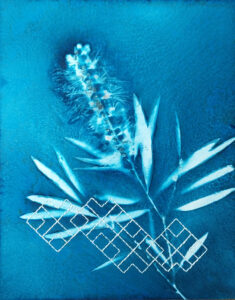
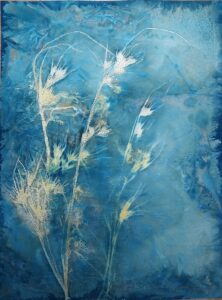
Place objects (eg botanicals) or a photographic negative on the sensitized surface. Keep it flat under glass.
4. Exposure
Expose the setup to sunlight or UV light. Light transforms the chemicals into insoluble Prussian blue.
5. Washing / Developing
Rinse the paper in water to wash away unreacted chemicals, revealing the blue-and-white image.
6. Finishing
Let the print dry. The blue tones deepen as the paper oxidizes. Optional toning with tea, coffee, or wine can alter the colors.
The Science Behind Cyanotype
The cyanotype process works through a simple iron-based chemical reaction:
– UV light reduces ferric iron (Fe³⁺) to ferrous iron (Fe²⁺).
– Ferrous iron reacts with ferricyanide to form ferric ferrocyanide (Prussian blue), a stable deep-blue pigment.
In essence, cyanotype is a contact printing process: coat → expose → wash → dry.